- +91-8045132343
- info@aepwater.com

Every day, large volumes of wastewater are generated from homes, residential societies, offices, hotels, educational institutions and commercial facilities. Water used for bathing, washing, flushing and other daily activities does not simply disappear after going down the drain. It becomes wastewater that needs to be managed responsibly.
This is where a Sewage Treatment Plant , commonly known as an STP, plays an important role.
A sewage treatment plant is designed to clean wastewater by removing contaminants, organic matter and suspended solids. Through a series of physical, biological and treatment processes, wastewater can be transformed into treated water suitable for discharge or selected reuse applications.
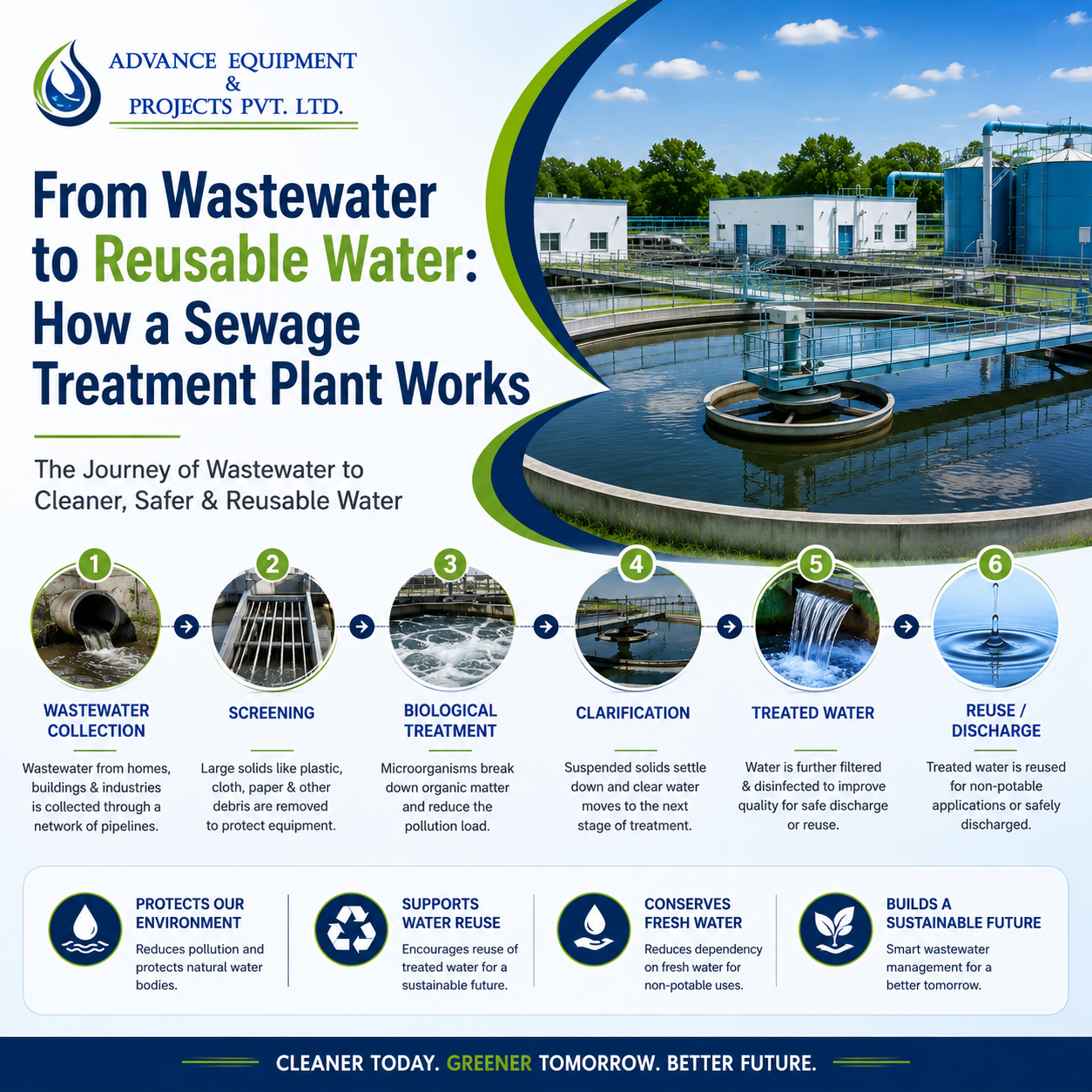
The journey from wastewater to reusable water is a carefully controlled process.
The Journey Begins: From Wastewater Collection to Initial Treatment
The treatment process starts when wastewater from different sources is collected and directed towards the sewage treatment plant.
At this stage, the wastewater may contain a variety of unwanted materials, including solid particles, organic waste, grease, paper and other debris. Before the main treatment process begins, larger materials are separated through screening and preliminary treatment.
This initial stage is important because it helps protect pumps, pipelines and other equipment used throughout the treatment system.
Once the larger unwanted materials are removed, the wastewater moves further into the treatment process.
Where the Real Cleaning Happens
After preliminary treatment, the wastewater enters the main treatment stages.
One of the most important parts of sewage treatment is biological treatment. In this process, naturally occurring microorganisms are used to break down biodegradable organic matter present in wastewater.
These microorganisms consume organic pollutants and help reduce the pollution load in the water.
Depending on the design of the sewage treatment plant, different biological treatment technologies may be used. Modern systems can use processes such as MBBR, SBR or MBR, while conventional biological treatment systems are also used for suitable applications.
The technology selected depends on factors such as:
- Quantity of wastewater
- Available installation space
- Required treated water quality
- Operational requirements
- Maintenance considerations
- Intended use of treated water
After biological treatment, the water goes through clarification and further treatment stages to separate the remaining suspended solids and improve the overall quality of treated water.
From Treated Water to Reusable Water
Once the main pollutants and suspended materials have been reduced, additional treatment may be carried out depending on the required water quality.
This can include filtration and disinfection processes.
The objective is to improve the quality of treated water so that it can be safely managed according to the requirements of the project.
Instead of considering all wastewater as waste, modern water management increasingly focuses on the potential reuse of treated water.
Depending on the treatment level and applicable requirements, treated water may be used for suitable non-potable applications such as:
- Gardening and landscaping
- Toilet flushing
- Floor and area cleaning
- Cooling applications
- Road washing
- Other approved non-drinking purposes
This approach can help reduce the unnecessary use of freshwater for activities that do not require drinking-quality water.
Why Water Reuse Is Becoming More Important
Freshwater resources are under increasing pressure due to population growth, urban development and rising water consumption.
At the same time, residential societies, commercial buildings and institutions continue to generate significant quantities of wastewater every day.
A properly designed sewage treatment plant creates an opportunity to manage this wastewater more responsibly.
Rather than simply disposing of used water, treatment systems can help convert it into a resource for appropriate reuse.
For large residential and commercial developments, this can support a more sustainable approach to water management. Treated water can reduce dependence on freshwater for selected non-potable activities while helping organizations manage wastewater in a controlled manner.
The idea is simple: use freshwater where it is truly needed and consider treated water for applications where drinking-quality water is unnecessary.
A Sewage Treatment Plant Is More Than Just a Waste Management System
Modern sewage treatment is not only about removing pollutants before wastewater is discharged.
It is also connected to environmental protection, water conservation and sustainable infrastructure.
A well-designed STP considers the complete journey of wastewater—from collection and treatment to final discharge or reuse.
For every project, the treatment approach may be different. A residential society may have different requirements from a hotel, commercial complex or institutional campus.
This is why the design of a sewage treatment plant should consider actual site conditions rather than relying on a one-size-fits-all solution.
Factors such as wastewater flow, available space, operating conditions and future water reuse requirements can influence the final treatment system.
The Future of Wastewater Management
The way we think about wastewater is gradually changing.
In the past, wastewater was mainly considered something that needed to be disposed of. Today, with increasing awareness about water conservation, treated wastewater is being viewed as a potential resource.
Sewage treatment plants are becoming an important part of sustainable building and infrastructure planning.
As cities expand and water demand increases, efficient wastewater treatment and reuse can help create more responsible water management systems.
The future is not simply about treating wastewater before disposal. It is about understanding how treated water can contribute to a more sustainable water cycle.
Final Thoughts
The journey from wastewater to reusable water involves several carefully planned treatment stages. From removing unwanted materials to biological treatment, clarification, filtration and final reuse, every step plays an important role in improving water quality.
A Sewage Treatment Plant helps transform used water into treated water that can be responsibly managed for discharge or suitable reuse.
As the importance of water conservation continues to grow, wastewater treatment will remain an essential part of modern residential, commercial and institutional infrastructure.
With the right treatment approach, wastewater is no longer just something to dispose of—it can become part of a smarter and more sustainable approach to water management.